A copper-wound coil alone does not identify a suitable 2/2 diaphragm valve: you also need the fail position, port standard, diaphragm compound, pressure differential, electrical rating and flow data. By the end, you will have a specification checklist for comparing sizes, confirming compatibility and requesting a technically comparable Delhi quotation.
Key takeaways
- 2/2 identifies two ports and two switching positions, not a 2-inch valve.
- Confirm NC or NO operation before ordering a replacement.
- Match pressure differential, media compatibility, port size and coil voltage.
- Request coil, seal, body, warranty and delivery details in the quotation.
What 2/2 means and which state the valve must hold
A 2/2 diaphragm valve has two ports and two switching positions; it is not a 2-inch valve. It controls one flow path between inlet and outlet. A normally closed (NC) model opens when its coil is energised and closes when power is removed. A normally open (NO) model does the reverse.
The supplied product description does not establish the default state, so require the exact model datasheet to state NC or NO.
| Specification | What to record |
|---|---|
| Function | NC or NO; fail position after power loss |
| Ports and direction | Inlet, outlet, flow arrow, allowable back pressure |
| Construction | Body; diaphragm; seat materials |
| Size and capacity | Nominal size; orifice diameter; Kv or Cv |
| Pressure | Maximum working pressure; minimum and maximum differential pressure |
| Temperature | Media and ambient limits |
| Coil | Voltage; AC or DC; AC frequency; power or VA |
| Electrical protection | Duty rating; insulation class; connector; enclosure rating |
The fail position affects safety: NC stops flow after power loss, while NO maintains flow until energised. For 2 2 diaphragm valve for copper coil specifications, treat “copper coil” only as a winding description, not a complete model.
Confirm the permitted medium and whether the valve needs inlet pressure to open; a pilot-operated diaphragm design can fail at zero differential pressure, unlike a direct-acting type.
The material and coil details that make a specification usable
Copper coil describes the electrical winding, not the fluid-contacting construction. Identify the body as brass, stainless steel or engineered polymer, then name the diaphragm and seat compound separately.
| Wetted material | Suitable use | Critical limit |
|---|---|---|
| NBR | Selected air and oil duties | Check compressor oil, condensate, ozone and temperature |
| EPDM | Many water and steam-related duties | Do not use it for oils without manufacturer approval |
| FKM or Viton | Selected oils and higher-temperature service | Exact compound limits control compatibility |
| PTFE | Media approved by the manufacturer | Confirm temperature, pressure and sealing design |
These materials are not interchangeable. For an airco diaphragm valve copper coil in delhi, require the exact compound code and permitted-media list rather than accepting “rubber seal.”
Specify the coil with all of these fields:
- 24 V DC, 24 V AC, 110 V AC or 230 V AC
- AC frequency, watts or VA, and 100% ED continuous-duty rating
- Insulation class and allowable ambient temperature
- Connector type and assembled IP rating
A DIN connector conforming to EN 175301-803 does not automatically give the assembled valve a particular IEC 60529 IP rating. The plug, gasket, cable entry and installation determine the completed enclosure protection.
Voltage tolerance, heat dissipation, armature design and duty rating matter more to reliability than the word copper. A copper winding alone does not prove lower heat, longer life or correct replacement performance.
Pressure differential, flow media and the direct-acting alternative
A pilot-operated diaphragm valve opens only when the available pressure differential meets its datasheet minimum. Specify the minimum and maximum differential pressure, allowable back pressure, and flow direction before approving the valve; insufficient differential pressure can leave it closed or prevent it from staying open.
| Valve type | Pressure requirement | Flow implication | Choose it when |
|---|---|---|---|
| Pilot-operated diaphragm | State minimum and maximum differential pressure, back-pressure limit, and flow arrow | Usually higher flow for a given port size | Inlet pressure and pressure drop always meet the datasheet |
| Direct-acting diaphragm or plunger | Operates at zero differential pressure; confirm its pressure and vacuum limits | Usually lower flow for the same port size | Low-flow circuits, tank outlets, vacuum-related duties, or lines that can sit at zero pressure |
Do not treat “air valve” as approval for water, oil, steam, oxygen, vacuum, or aggressive chemicals. Require a permitted-media list for the exact model, including media temperature and seal compatibility.
For compressed air, confirm lubricated or non-lubricated operation, compressor-oil exposure, condensate, ozone resistance, and operating temperature. NBR, EPDM, FKM and PTFE are not interchangeable.
Obtain separate written confirmation for hot water, steam, oxygen and corrosive gases. Give the supplier the actual medium temperature and ask which diaphragm and seat compounds are approved; a valve that handles dry air can fail rapidly in hot steam, oxidising oxygen service, or corrosive gas.
How to choose the port size and check a Delhi replacement installation
Do not choose among 1/2-inch, 3/4-inch, 1-inch, 1-1/2-inch and 2-inch 2 2 diaphragm valve sizes from nominal pipe size alone. Match required flow, inlet pressure, outlet pressure, pressure drop, medium and the manufacturer’s Kv or Cv value.
| Port size | Orifice diameter | Kv/Cv |
|---|---|---|
| Connection opening | Internal flow passage | Rated flow capacity |
Request the orifice diameter separately: these three measurements are different. For a pneumatic cylinder, provide bore, stroke and target speed so the supplier can estimate air demand.
Specify BSP or NPT, then state male or female thread. An inch thread designation is not the pipe’s measured outside diameter in millimetres. Ask for these installation details:
- Flange standard, if offered, and port orientation
- Flow-arrow direction
- Overall height, body width and coil height
- Centre-to-centre dimensions
- Clearance needed to remove the coil
Check the existing manifold or line with a thread gauge before ordering. Measure the installed envelope, including access for spanners and coil removal. A BSP and NPT thread can appear to share the same nominal size while having different profiles; forcing them together can cause leakage or damage the valve body.
Match the replacement to the manufacturer’s drawing, not a visual resemblance.
What to include in a Delhi quotation request and how to compare price
A useful Delhi quotation starts with operating data, not “airco diaphragm valve copper coil.” That phrase is not a universal model designation, so a visually similar replacement can have the wrong voltage, orifice, connector or temperature rating.
- Medium: air, water, oil, steam or other specified fluid
- Minimum, normal and maximum pressure
- Required flow, or cylinder bore and target speed
- Media temperature and ambient temperature
- Port size and BSP or NPT standard
- NC or NO function
- Body, diaphragm and seat materials
- Coil voltage
- AC frequency or DC
- Watts or VA
- 100% continuous-duty requirement
- Connector type
- Quantity
- Delivery location
- Exact manufacturer part number
Request the valve datasheet, coil code, replacement-coil dimensions, warranty terms and stock condition. A diaphragm valve supplier in Delhi should confirm these fields instead of sizing from port diameter alone. Multitech Pneumatics And Hydraulics is useful for comparison when it supplies that matching documentation.
There is no single copper coil solenoid valve price. Ask for an itemised offer so competing quotes show the same scope.
| Quote line | Compare | Why it changes the price |
|---|---|---|
| Valve body | Brass, stainless steel or polymer; orifice | Material and flow capacity differ |
| Coil | Voltage, AC/DC, watts or VA, duty rating | Electrical construction differs |
| Connector | DIN or other specified type | Connector and enclosure options differ |
| Seals | NBR, EPDM, FKM or PTFE | Media and temperature suitability differ |
| Commercials | Brand, quantity, GST, freight and warranty | The delivered total changes |
Related product
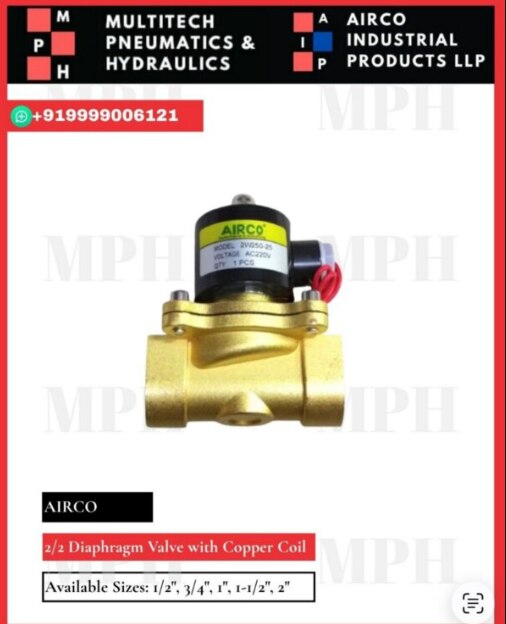
 | Airco 2/2 Diaphragm Valve with Copper Coil Available Sizes: 1/2“, 3/4”, 1“, 1-1/2”, 2" 1/2 inch 3/4 inch 1 inch 1-1/2 inch 2 inch These size options make the valve suitable for both small-scale and large industrial systems. View product → |
Frequently asked questions
What does 2/2 mean on a diaphragm valve?
2/2 means the valve has two ports and two switching positions controlling one flow path. It does not mean a 2-inch valve.
How do I choose between a normally closed and normally open valve?
Choose normally closed when the valve must shut after power is removed. Choose normally open when flow must continue without energising the coil.
What copper coil details belong in a valve specification?
Specify the coil voltage, AC or DC supply, frequency where relevant, power rating, insulation or enclosure details, connector type and duty cycle.
How do pressure differential and flow media affect valve selection?
Check the minimum and maximum differential pressure and confirm that the diaphragm, body and seals suit the media temperature and chemical composition.
How should I compare a copper-coil solenoid valve price in Delhi?
Compare the complete specification, including valve size, body and seal materials, coil voltage, pressure range, warranty, taxes, delivery and replacement parts.
Keywords