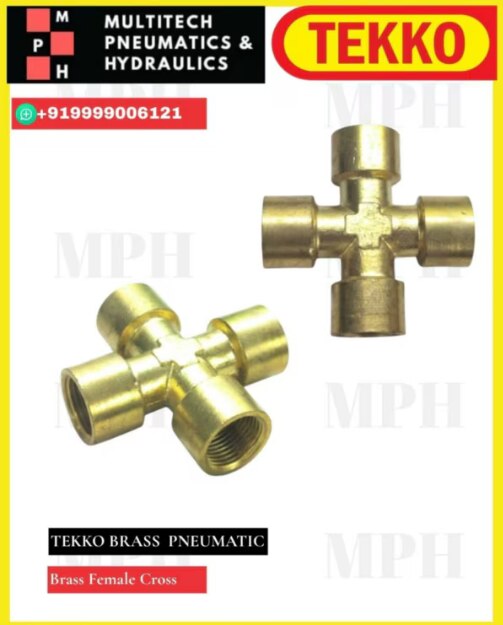
A brass female cross is specified by four threaded ports, but a size such as 1/4 inch does not identify the thread standard, outside dimensions or usable airflow. By checking each port, thread form, passage size, pressure limit and circuit position, you can order a fitting that actually matches the pneumatic system rather than relying on an incomplete “1/4-inch brass cross” description.
Key takeaways
- Confirm all four ports use the required female thread standard.
- Do not treat nominal thread size as the measured outside diameter.
- Use a pneumatic female cross for branching air, not controlling flow.
- Ask suppliers for thread details, material grade and inspection records.
What a brass female cross fitting is—and how it differs from similar parts
A brass female cross is a four-port junction with female threads on every port: two ports lie on the straight-through axis, while two branch ports meet that axis at right angles. This female cross brass fitting creates a connected passage for compressed air; it does not regulate, meter or shut off flow.
An equal cross has the same nominal thread size at all four ports. A reducing cross requires a port schedule, such as 1/2 x 1/2 x 1/4 x 1/4, because one overall size does not describe its connections.
| Part | Port arrangement | Function |
|---|---|---|
| Female tee | Three female ports | Joins one inlet to two outlets, or two inlets to one outlet |
| Mixed-gender cross | Four ports with male and female connections | Fits assemblies that require different connection genders |
| Manifold | Designed internal passage with a specified port layout | Distributes flow through an engineered body, not necessarily a symmetrical cross |
| Four-way directional valve | Four working ports with switching elements | Actively routes, isolates or switches airflow |
A pneumatic female cross fitting is passive: it cannot switch a cylinder, isolate a branch or control pressure. Use a valve, regulator or shut-off valve for those jobs.
Treat every unused port as a leakage point. Close it with a correctly matched plug using the same thread standard, size and suitable sealing method; never leave a branch open.
Brass female cros sizes in Delhi: nominal threads are not measured diameters
A 1/4-inch port is a nominal pipe-thread family, not a 1/4-inch thread diameter. Build brass female cros sizes in delhi around 1/8, 1/4, 3/8 and 1/2 inch, then confirm actual stock, thread standard and rating before requesting 3/4 or 1 inch.
An equal cross has the same nominal size at all four ports; a reducing cross needs a separate size for each port. A 1/4-inch tube is different: specify its outside diameter and use a connector made for that tube, not automatically a 1/4-inch threaded female cross brass fitting.
Thread designation must appear separately from size:
| Thread designation | Meaning | Ordering example |
|---|---|---|
| G | BSPP parallel thread under ISO 228-1; sealing normally occurs with an O-ring, washer or face seal | G 1/4 |
| R | BSPT tapered pressure-sealing thread under ISO 7-1 | R 1/4 |
| NPT | American tapered pipe thread with its own pitch and form | 1/4 NPT |
Do not force NPT into BSP; similar-looking threads can damage ports and leak. Ask for these installation dimensions when cabinet or machine clearance matters:
- Overall length and branch spacing
- Wrench-flat size and port depth
- Internal passage or minimum bore
- Required installation envelope, including tool access
A supplier’s “brass female cros” label is incomplete without the port schedule, thread standard and pressure rating. Two fittings with the same nominal size can have different flow capacity and physical envelopes.
How to verify every port before ordering
Start with four female ports, not one fitting size.
Mark the two ports on the straight-through axis as A and B, then mark the two branches as C and D. For brass female cros sizes in Delhi, record a separate designation and nominal size for every port; a reducing cross must never be ordered as one overall size.
- Check the mating connection: male or female.
- Measure a male thread across its outside diameter, or a female thread across its inside diameter.
- Compare pitch with a thread gauge or the manufacturer’s drawing.
- Record the result as BSPP, BSPT or NPT beside each port.
BSP and NPT can look alike but differ in pitch and thread form. Do not rely on appearance.
| Thread type | Identification and sealing |
|---|---|
| BSPP | Parallel thread; normally seals with an O-ring, bonded washer, gasket or face seal. |
| BSPT | Tapered thread; use the specified sealant or sealing tape. |
| NPT | Tapered American thread; use its specified sealant and never substitute it for BSP. |
Compare the fitting drawing with the machine layout. Check wrench access, tube bend radius, branch direction, thread engagement, and clearance around gauges or valves. A fitting that threads in but blocks a spanner is still the wrong part.
Never force BSP into NPT. Close every unused port with a matching plug, confirming its thread standard, material and sealing method.
Where a pneumatic female cross belongs in a compressed-air circuit
Install a pneumatic female cross fitting downstream of an isolation valve and filter-regulator-lubricator when one prepared-air source must serve several branches. Filtration, draining and air preparation remove moisture and particles that would otherwise damage downstream valves and cylinders.
| Branch arrangement | Practical use |
|---|---|
| Main line plus valve branch | Continue the trunk line while feeding a directional control valve and cylinder |
| Two valve branches | Feed a second valve or actuator from the same prepared-air source |
| Instrument branch | Connect a gauge or pressure switch for local monitoring |
| Service branch | Add a pressure-test point, compact machine bypass, or a plugged spare port |
The fourth port can continue the main line or be closed with a correctly matched plug. A brass female cros can also join four short pneumatic runs, but it remains a passive junction: it cannot switch a cylinder, isolate a branch, meter flow or regulate pressure.
The directional control valve, isolation valve and regulator perform those jobs.
Choose the cross by required flow and its smallest effective passage, not by nominal thread size alone. Abrupt turns and the four-way cavity add pressure loss, so a matching thread can still be unsuitable for a high-flow valve inlet.
Push-in connectors and tubing require separate checks for connector thread and tube outside diameter. A 1/4-inch tube does not automatically suit a 1/4-inch threaded cross.
What to ask a brass cross fitting supplier in Delhi before buying
A quotation is incomplete if it says only “pneumatic female cross fitting.” Use this checklist, especially when comparing brass cross fitting supplier in Delhi:
1. Request the four-port configuration and identify the straight-through pair and two branch ports. State whether it is equal or reducing, then list the nominal size of every port separately. Specify BSPP, BSPT or NPT for each port, not simply “brass female cros sizes in Delhi.”
2. Ask for the brass alloy or grade, finish or plating, internal passage, working-pressure limit, temperature range, compressed-air quality requirement, and inspection or conformity documents. Check the pressure rating at your operating temperature and against the weakest component: tubing, push-in connector, gauge, valve, adaptor or plug.
3. Confirm that the fitting is rated for compressed air, rather than hydraulic oil or another aggressive medium. Request the seal material and confirm compatibility with your sealant; excess tape or paste can narrow the bore, contaminate valves or crack the fitting.
Ordinary brass is not a substitute for stainless steel in seawater, ammonia-containing environments or corrosive condensate.
Multitech Pneumatics And Hydraulics is one source to ask for this port-by-port specification before accepting a catalogue description. Also request the drawing and installation envelope if wrench access, branch spacing or clearance around gauges matters.
Related product
 | TEKKO BRASS PNEUMATIC TEKKO BRASS PNEUMATIC Brass Female Cros View product → |
Frequently asked questions
What is a brass female cross fitting?
It is a four-port junction with female threads on every port: two straight-through ports and two ports at right angles. It connects air passages but does not regulate, meter or shut off flow.
How do you choose brass female cross sizes in Delhi?
Confirm each port’s nominal thread size and thread standard, then verify the actual thread form and dimensions with a gauge, sample fitting or supplier drawing. Nominal size is not the same as measured diameter.
How do you verify every port before ordering?
Record the thread standard, nominal size, port orientation and required seal method for all four ports. Ask the supplier to confirm these details in writing against your order.
Where does a pneumatic female cross fitting belong in a compressed-air circuit?
Install it where one compressed-air line must branch into three connected directions, such as a manifold or distribution point. Do not use it as a substitute for a valve, regulator, filter or flow-control device.
What should you ask a brass cross fitting supplier in Delhi before buying?
Ask for the thread standard, nominal sizes for all ports, brass grade, pressure and temperature ratings, sealing guidance, dimensional drawings and inspection or batch documentation.
Keywords