“Double decker high-low valve” is a trade-search phrase, not a complete technical specification. You will be able to identify the valve’s actual switching function, verify its pressure, port, flow and control requirements, and send a supplier a purchase specification that avoids incompatible replacements.
Key takeaways
- Confirm whether high-low means pressure changeover, sequencing or a stacked layout.
- Match inlet, outlet and exhaust ports to the circuit drawing before ordering.
- Size the valve from cylinder force, stroke speed, pressure and required airflow.
- Send pressure, thread, material, quantity and application details to the supplier.
What does a double-decker high-low valve do in a pneumatic circuit?
A double-decker high-low valve routes air through a two-tier or stacked valve/manifold arrangement; “double-decker” describes the physical layout, not a universal function. “High-low” usually means selecting or changing over from a low-pressure supply to a high-pressure supply, or sequencing those pressures.
It does not automatically mean pressure relief, and both pressure sources are not assumed to be available simultaneously.
Request an ISO 1219 circuit symbol and a port/function diagram before comparing quotations. The drawing must show every inlet, outlet, flow path and valve position. Confirm these points:
- Whether it is a 3/2, 5/2 or 5/3 directional-control valve
- Whether each relevant port is normally open or normally closed
- Whether operation is manual, pneumatic, pilot-operated or solenoid-operated
- Whether it controls a single-acting cylinder, double-acting cylinder, clamping circuit or exhaust function
- Whether it selects pressure, sequences pressure, isolates a supply or provides another function
- Whether it releases trapped downstream air when the supply closes
A high-low quotation must separately state the low-side pressure, high-side pressure, changeover pressure and hysteresis. Ask whether the valve relieves excess pressure; selection and relief are different functions.
The phrase double decker pneumatic valve in Delhi is not enough to identify a replacement. Two valves can look alike while having different port counts, positions, mounting dimensions or flow paths, so match the symbol and function—not the trade name.
Which pressure, port and material specifications must you verify?
Before comparing prices, require a quotation that states the high-side and low-side operating ranges, maximum inlet pressure, outlet-pressure range, changeover pressure, hysteresis, allowable pressure differential and proof pressure. It must also say whether the valve relieves excess pressure; “high-low” does not automatically mean pressure relief.
“1 by 2 inch double decker valve” is unsafe wording. It could mean 1/2-inch nominal ports, a 1-inch-by-2-inch physical dimension or a transcription error. Put these details on the purchase order:
- Exact port size, thread form and standard: BSPP, BSPT, NPT or another named standard
- Port orientation, mounting-hole pattern and mounting dimensions
- Body and seal materials, pneumatic-air compatibility, temperature range and leakage rating
- Expected service life and confirmation that the medium is compressed air, not hydraulic fluid
| Item to verify | What the quotation must identify | Failure if omitted |
|---|---|---|
| Pressure | High and low ranges, maximum inlet, outlet range, changeover pressure and hysteresis | Wrong switching point or unstable output |
| Mechanical limit | Allowable pressure differential and proof pressure | Body or seal damage during operation |
| Pressure function | Relief or non-relief operation | Excess pressure remains trapped |
| Connection | Port size, thread standard and orientation | Non-interchangeable valve |
| Materials | Body, seals, air compatibility and temperature limit | Swelling, leakage or premature failure |
| Performance | Leakage rating and service-life figure | Unplanned maintenance |
Do not substitute a pneumatic valve for a hydraulic valve because the ports look similar; hydraulic pressure and fluid compatibility require different bodies, seals and internal clearances.
How do you size the valve for a cylinder, compressor or automation line?
Size the valve from required flow and allowable pressure drop, not nominal port size. Ask for Cv or ISO 6358 sonic conductance and critical pressure ratio, together with inlet pressure, outlet pressure and required flow. A large port can still undersupply a cylinder if its flow coefficient is low.
For a cylinder, use these preliminary checks:
- Force ≈ pressure × effective piston area.
- Air flow ≈ piston area × target piston speed.
- Recalculate the return stroke with rod-side area and exhaust flow.
- Include tubing length, fittings, pressure losses, duty cycle and simultaneous movements.
- Confirm flow at the actual inlet and outlet pressures, not at a catalogue test condition.
| Application | Questions to answer | Sizing consequence |
|---|---|---|
| Compressor discharge | What are discharge pressure, receiver pressure, temperature and peak flow? | Check maximum inlet pressure, heat rating and pressure drop. |
| FRL assembly | What filter, regulator and lubricator flow must pass together? | Size the valve for the combined rated flow. |
| Double-acting actuator | What are bore, rod diameter, stroke, speed and cycle rate? | Calculate cap-end supply and rod-side exhaust separately. |
| Clamping system | What force is required, and can pressure change suddenly? | Verify force margin, changeover repeatability and pressure shock. |
| Automation line | Which devices move simultaneously, and what is the longest tube run? | Add coincident demand, tubing losses and switching time. |
A high-low changeover can cause pressure shock or a sudden force increase. Use a regulator, soft-start valve or controlled exhaust when the actuator or load cannot tolerate that step change.
State air quality by ISO 8573-1: specify particulate class, water class and oil class, including liquid water and oil carryover limits. “Clean air” is not a usable specification.
When is a high-low valve the wrong choice?
A high-low valve is the wrong choice when the circuit needs independent pressure control, coordinated actuator movements or service isolation rather than simple pressure selection.
| Option | Function | Control and pressure implications |
|---|---|---|
| Separate pressure regulators | Set each branch independently | Two continuously adjustable pressures; no automatic source changeover |
| Pressure-reducing valve | Produces one regulated downstream pressure | Does not select between two inlet sources |
| Two independently controlled valves | Control separate movements or timed stages | Best for feedback, sequencing, independent exhaust and simultaneous pressures |
| Shuttle valve | Selects one of two inlet signals or sources | Useful for signal or source selection, not a universal pressure-sequencing or relief device |
| Two independent valves | Separate, isolatable flow paths | Preferable for maintenance isolation, redundancy and lockout |
Choose separate valves when timing, feedback or actuator movement matters. They also give you clearer switching-time control and make changeover repeatability easier to verify, while a high-low transition can cause pressure shock and a sudden force increase.
Before approval, compare the circuit by function, number of control signals, whether both pressures must exist simultaneously, repeatability, switching time and residual-pressure release. Add a regulator, soft-start valve or controlled exhaust if the pressure step could damage the actuator or workpiece.
Trace the trapped air volume between each valve and actuator. Specify its exhaust path, the lockout or isolation arrangement and whether a residual-pressure dump is required; shutting the supply alone does not prove that this volume is safe.
What should you send a Delhi supplier before placing the order?
A like-for-like quotation starts with evidence from the installed valve, not the words “double decker” or “1/2 inch.” Send the supplier the existing nameplate, coil marking, photographs of every side, circuit symbol, port spacing, mounting-hole pattern, port orientation, application pressure, medium, actuator model and required cycle rate.
1. Ask the supplier to confirm the valve function and ISO 1219 symbol, port configuration, thread standard, pressure ranges, flow rating, temperature range and seal material. State whether the circuit needs low-to-high changeover, pressure selection, exhaust control or another function.
2. Request the actuation method, coil voltage and AC/DC type, power consumption, connector, ingress-protection rating, duty cycle and manual-override arrangement. Also ask for spare-part availability, a test certificate and warranty. A correct port size with the wrong coil voltage is not an interchangeable valve.
3. Compare the completed schedule with the quotation, including port dimensions and mounting details. Multitech Pneumatics And Hydraulics can be approached as a Delhi source for this technical comparison, but judge any double decker high low valve dealer in Delhi or high low pressure valve supplier against confirmed specifications rather than catalogue wording.
If the supplier cannot state the port, function, pressure range and control details in writing, stop the order and resolve the mismatch. Buy high low valve in Delhi only after those four points, plus the electrical and mounting details, are confirmed on the quotation.
Related product
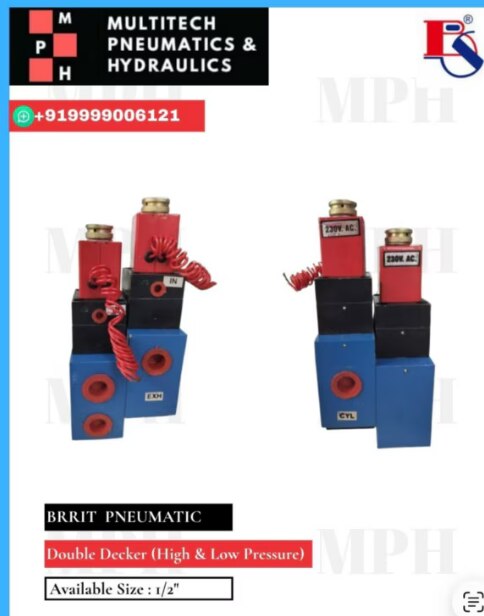
 | BRRIT PNEUMATICS Double Decker (High & Low Pressure) Available Size : 1/2" Double Decker (High & Low Pressure) Available Size : 1/2" View product → |
Frequently asked questions
What does a double-decker high-low valve do in a pneumatic circuit?
Double-decker describes the stacked physical arrangement. High-low usually refers to selecting between low- and high-pressure air supplies or sequencing those pressures, so confirm the manufacturer’s circuit symbol and operating logic.
Which pressure, port and material specifications must you verify?
Verify minimum and maximum inlet pressure, switching pressure, pressure rating, port size, thread standard, flow direction, exhaust arrangement, body material and seal material. Do not assume a 1 by 2 inch designation identifies the same ports or thread standard across suppliers.
How do you size the valve for a cylinder, compressor or automation line?
Start with cylinder bore, operating pressure, required force, stroke time and cycle rate. Then match the valve’s rated flow and port size to the airflow demand, while checking compressor capacity and pressure drop through tubing, fittings and silencers.
When is a high-low valve the wrong choice?
Choose another arrangement when the circuit needs precise proportional pressure control, independent closed-loop regulation, rapid continuous modulation or flow capacity beyond the valve’s rating. A regulator, proportional valve, separate directional valves or a manifold may fit better.
What should you send a Delhi supplier before placing the order?
Send the circuit diagram, air pressure range, cylinder details, port and thread requirements, material preference, operating temperature, connection layout, quantity, delivery location and the required changeover or sequencing function.
Keywords